How to Build Technology that Drives Trust, Usage, and Improves Outcomes

Technology is one of the most important tools to help power success across industries. It was a big topic of conversation at the recent Accelerate Conference, Women in Trucking event. Many of the conference sessions focused on leveraging technology, building systems to optimize trucking and fleet performance, and other adjacent topics. However, even with the power of technology to transform teams and improve performance, there is a question that every fleet, OEM, and technology provider should be asking…
Are we designing technology that supports drivers and feet performance, or overwhelms them?
It’s a question that warrants discussion, especially as technology-enabled fleets are standard today and connectivity in trucking is rapidly shaping the industry. We brought the question of connectivity, safety, design, AI, and fleet operations to a panel we hosted at Accelerate entitled, The Future of Connected Trucking: Safety, Design, and Driver Experience. Innovative leaders including Melanie Vittitow from UPS, Kam Roshan from Fleetworthy, Krys Grondorf from Phillips Connect, and Brittany Chance from Sparq shared their insights and experiences to help solve some of the complexities facing teams today.
The key takeaway? The future of connected trucking is human.
The panel agreed that the future of the industry is not just connected. It’s not simply automated. The future of connected trucking is human-centered, empathetic, inclusive, and designed as a holistic ecosystem. It takes more than just connected systems to drive success and too often, it involves a complex journey to get there.
Sparq works to help minimize complexity and enable a clear path to success for our clients.
To help teams on their path to success, it’s important to assess where they are on their journey. Sparq has developed some questions to help clients as they embark on this journey and they stem from principals of inclusive and empathetic design. The questions are designed to spark reflection and drive better decisions across product, safety, operations, and technology strategy to help foster the human element needed in connected trucking.
Below are key elements for building technology that drives trust, increases usage, and improves outcomes:
1. From Data Overload to Strategic Clarity
Modern Class 8 trucks produce thousands of data points per minute. It includes telematics, sensors, and AI systems that can now predict failures, surface risks, and automate workflows. However, more data doesn’t automatically mean safer or more efficient fleets.
Our panelists emphasized a key message: Connectivity only drives safety when the information is meaningful.
Questions to Consider
- Are you drowning drivers in information, or guiding them with the few data points that actually keep them safe and productive?
- Can a driver tell at a glance what matters or do they need a manual to decipher the data?
- When a new alert or dashboard is added, who decides what’s enough? And how does that impact performance?
Panel Insights
- Data without context is noise
- Thoughtful design turns data into trust
- Safety tools succeed when they surface the right information at the right moment, not when they overwhelm drivers with dashboards and alarms
2. Human-Centered Design: Technology Only Works When Drivers Use It
Drivers work under intense pressure including facing challenging weather conditions, tight schedules, changing regulations, and operator fatigue. Every tap, lag, or unnecessary workflow disrupts their focus and affects safety. The biggest design risk in connected trucking solutions isn’t missing a feature, it’s missing the human behind the feature.
Questions to Consider
- Do your teams observe driver workflows before designing new features?
- How many decisions in your last release came from empathy interviews vs. assumptions?
- Have you measured the cost of friction - in time, safety, or dollars?
- Does your technology quietly assist drivers — or constantly demand their attention?
Panel Insights
- Great technology fades into the background
- Bad technology forces itself into view
- Human-centered design reduces cognitive load and builds natural adoption by making tools intuitive, predictable, and respectful of driver reality
3. Inclusive Design Is Strategic Design
The blind spots in connected trucking are a result of designing in a silo. This can cause a lack of unique perspective, whether for women drivers, small fleets, specialized haulers, or independent operators. All of this impacts the effectiveness of a solution and ultimately, driver adoption before real benefits can be capitalized. Inclusive and empathetic design go hand in hand to deliver better outcomes.
Questions to Consider
- When was the last time a woman driver, small-fleet owner, or independent operator influenced a tech decision?
- Does your feedback loop reach the people who experience the most friction — or only the loudest users?
- Do your technology reviews ever include someone who isn’t in management?
- How diverse is the dataset or feedback pool that informs your “average user”?
Panel Insights
- Trucking is not a monolith
- Technology that works beautifully for one group may create friction for another and friction equals risk
- Empathy isn’t a checkbox. It’s a strategy. Products built with diverse perspectives are adopted faster, trusted more deeply, and work across more use cases. Trucking is not a monolith.
4. The Holistic Fleet: Designing for Flow, Not Fragments
Fleets operate as connected ecosystems, not isolated apps, portals, or devices. When a workflow breaks, the impact ripples across drivers, dispatch, safety, maintenance, and compliance.
Questions to Consider
- Does your tech stack feel like an ecosystem or a patchwork?
- When one part of the system changes, who feels the ripple first?
- Are your teams (product, IT, safety, ops) aligned on shared goals?
- What’s one workflow you could simplify by connecting systems instead of adding another tool?
Panel Insights:
- The best-designed systems don’t just report, they orchestrate
- Holistic design means the driver, back office, and equipment all operate in harmony. The ecosystem is supported, not burdened, by technology.
5. The Technology Landscape: Sensors, AI, Maintenance, and Predictive Insight
The increased use of AI means data is more available than ever before. The technology landscape for connected trucking includes different core platforms and it must tightly integrate data from across the ecosystem that includes three key areas:
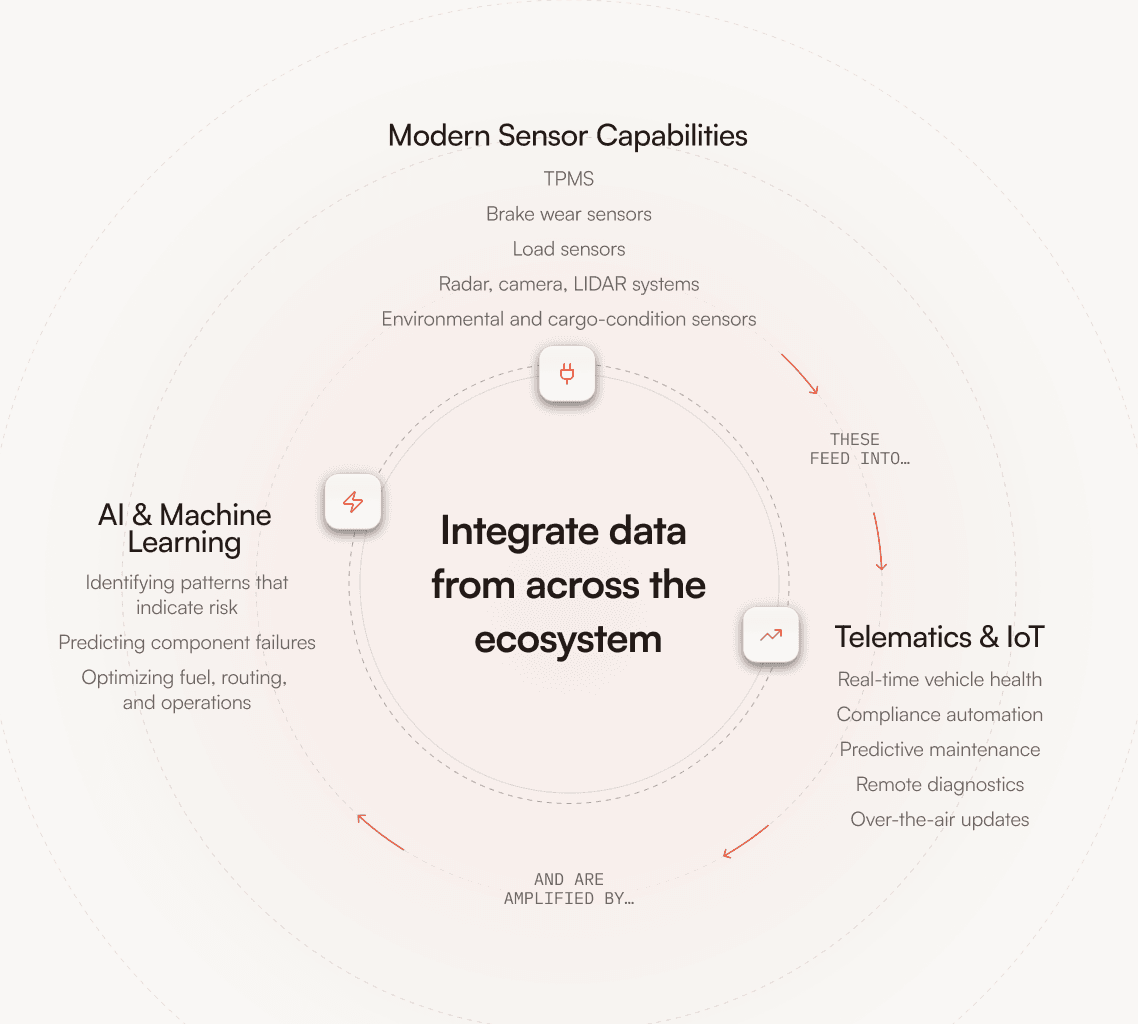
This ecosystem data is only truly valuable when the information is cohesive and delivered in a way a human can understand and act on. Without the ability to action or leverage the data, effectiveness is minimized and adoption limited.
Key Takeaways for the Future of Connected Trucking
The future of connected trucking isn’t about replacing people with technology. It’s about building technology that solves business needs and amplifies human abilities to maximize effectiveness. When connectivity enhances safety and cuts through the noise, data becomes clear, contextual, and useful.
Human-centered and empathetic design drives real adoption, turning features into meaningful solutions for the people using the technology. Inclusive design brings diverse perspectives to the table, reducing blind spots and strengthening trust at scale. By viewing a fleet as an interconnected ecosystem, teams create systems and leverage technology that drives trust, increases usage, and improves business outcomes.
To learn more about how Sparq builds connected solutions for the travel, transportation, and logistics industry, visit us here.
Sparq is an AI-native digital engineering firm that re-engineers the systems businesses run on, turning operational bottlenecks into margin, throughput, and decision speed. Our work spans legacy modernization, connected data and AI, workflow optimization, and production-ready agentic systems that execute decisions inside governed guardrails. Headquartered in Atlanta, Georgia, and with senior-led delivery teams across the U.S. and Latin America, Sparq serves Fortune 1000 and enterprise clients across industries, including transportation & logistics, real estate & construction, and financial services & insurance.
Related