Astronaut in a space suit leaning over a cluttered workshop workbench with tools and parts.

The fastest path to margin isn't more engineers. It's better engineering.

Why Sparq?

The firms you've been evaluating sell hours, headcount, and transformation roadmaps. Sparq sells economic performance: measurable margin, throughput, and growth engineered precisely into the operational systems your business depends on.

How you buy engineering determines what it produces.

Most engineering partner evaluations start with input metrics like rates, team size, location, and methodology. Those measure what you're buying. The organizations seeing real economic returns from modernization have shifted the evaluation entirely, from how many people are working to how fast margin improves.


That shift requires a fundamentally different kind of partner.


The Sparq Model

The Economic Performance Engineering Model

Sparq is built for enterprises where earnings depend on complex operational systems. We work in the performance engine: the operational layer where business logic, workflows, and decisions are executed, and where margins are determined.


How the model works:


We start with the economics.

Every engagement begins with the same question: where is margin leaking, and where has it been left on the table? We map the full economic picture before we write a line of code.

We build on what you have.

We engineer intelligence into your existing systems and workflows. Your operations keep running. Your modernization investments start producing measurable returns.

We deploy intelligence that's safe at scale.

Autonomous agents, governed data access, deterministic QA, and real-time observability are built into every deployment. Intelligence reaches production with the governance required to run in earnings-critical environments.

We compound what we learn.

We capture patterns and outcomes from every engagement. Operators arrive with earned intelligence from hundreds of prior deployments. Each project makes the next one faster, safer, and more precise.

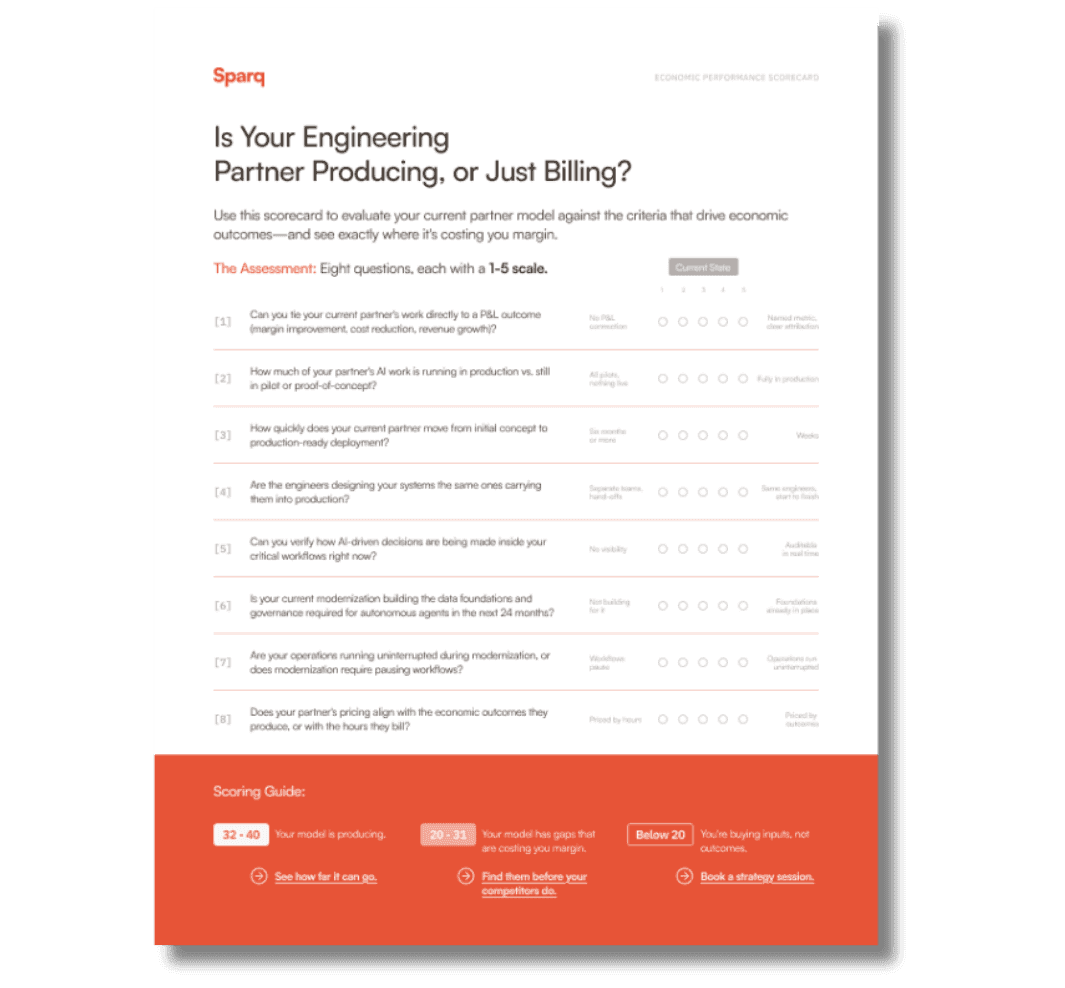
Evaluate your current partner model on the metrics that matter.

Most partner evaluations score vendors on inputs: rates, team size, delivery methodology. This scorecard evaluates on outputs: economic impact, production readiness, operational risk, and speed to measurable value. Use it to assess whether your current partners are engineering earnings or just billing hours.

Webpage with a questionnaire titled 'Is Your Engineering Partner Producing, or Just Billing?'

Two models. Different physics.

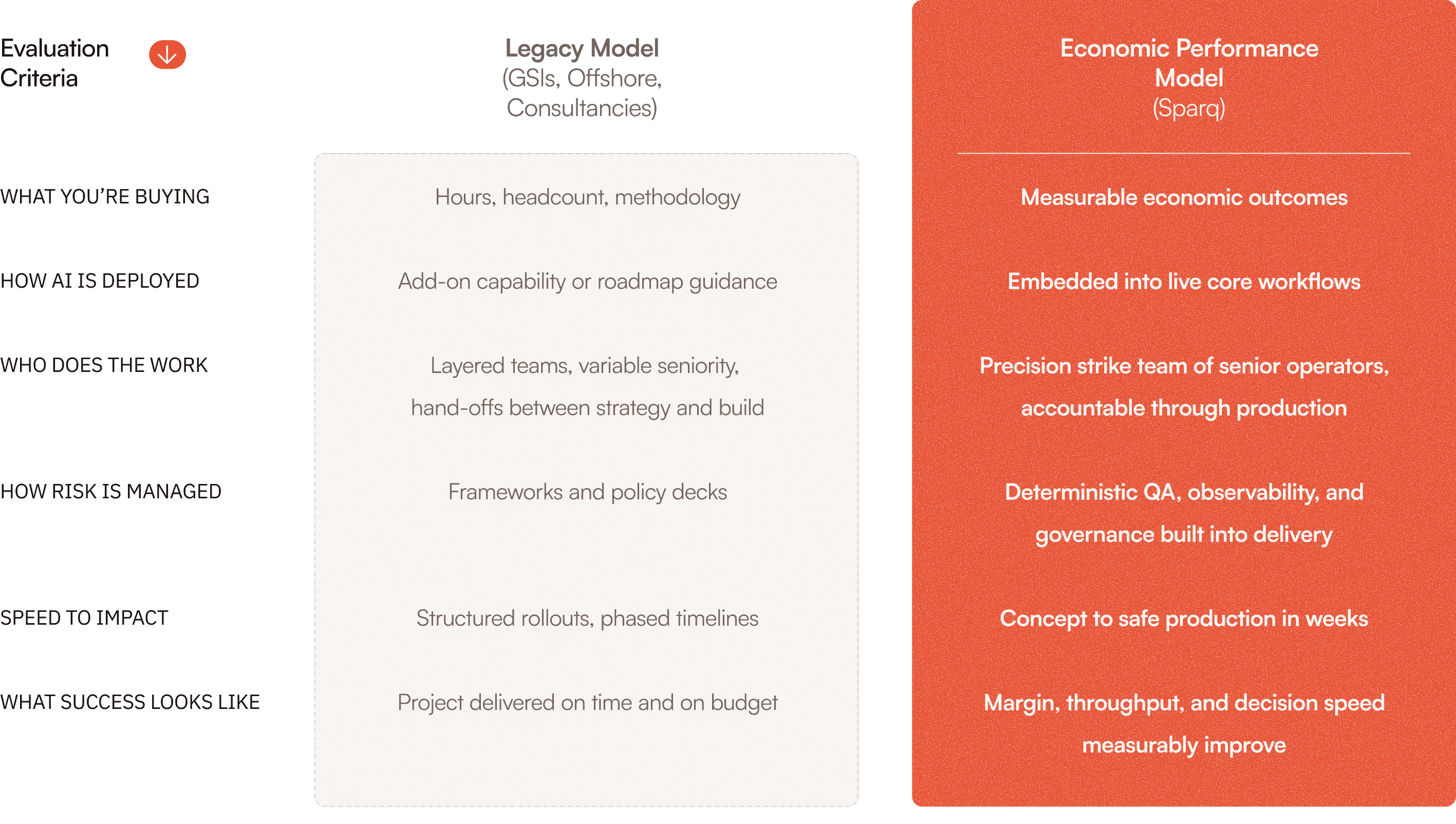
The traditional engineering services model optimizes for utilization: filling seats, billing hours, extending timelines. The economic performance model optimizes for impact: compressing timelines, embedding intelligence, and tying every engagement to measurable business outcomes.

A comparison chart outlining differences between the Traditional and Economic Performance Models.

Commercial Impact

Engineering decisions are financial decisions.

Margin Recovery

$90M in annual gross margin unlocked for a global mobility leader through an AI decisioning engine that generates $50-$100 in additional revenue per vehicle.

Processing Economics

Mortgage document validation for a financial institution dropped from hours to 8 seconds: a 99% reduction in processing time and cost.

Speed-to-Value Economics

A policy intelligence workflow for an insurance provider moved from concept to production in under 20 days, cutting ticket creation time by 90%.

Agentic Readiness

75% of mid-market enterprises are targeting AI-agent readiness within 24 months. Every quarter without governed, autonomous execution is a quarter your competitors use to widen the margin gap.

Map the economic picture before you commit to anything.

A strategy session with Sparq starts the same way every engagement does: identifying where margin is leaking and where it's been left on the table. It's a working conversation, not a sales motion, and you leave with a clearer picture of what your current partner model is and isn't producing.

Related