Deploying Claude from pilot to production: a practitioner's playbook for governance and safe rollout
Deploy Claude from pilot to production in four phases. Sparq's playbook covers governance, access controls, spend caps, and ROI measurement from real deployments.

Most Claude pilots do not fail on model quality. They stall when security asks who can reach what, finance asks what it costs per developer, and nobody can show what the pilot changed. This playbook covers the four phases we use to get Claude from a pilot group to production, with the specific controls we put in place at each one.
It draws on deployments we delivered for a private equity firm, a large US services company, a fire protection manufacturer, and a customer experience management company, plus our own internal rollouts. Sparq is a Select partner in the Claude Partner Network Services Track. See our Anthropic services and credentials for details.
The short version
- Start with visibility. Find out where Claude is already in use before you write policy.
- Put governance at the point of action (what an agent can touch) before you put it at the point of consumption (how many tokens it can use).
- Roll out in stages. Prove controls with a small group, then widen.
- Test before production. Anything that touches live data gets validated in a sandbox first.
- Measure from day one. Most of the deployments we reviewed had estimates or self reports, not a measured before and after. Set the baseline before launch.
Phase 1: Establish visibility
Goal: Know what is already in use, who owns the Claude account, and which surface each team uses.
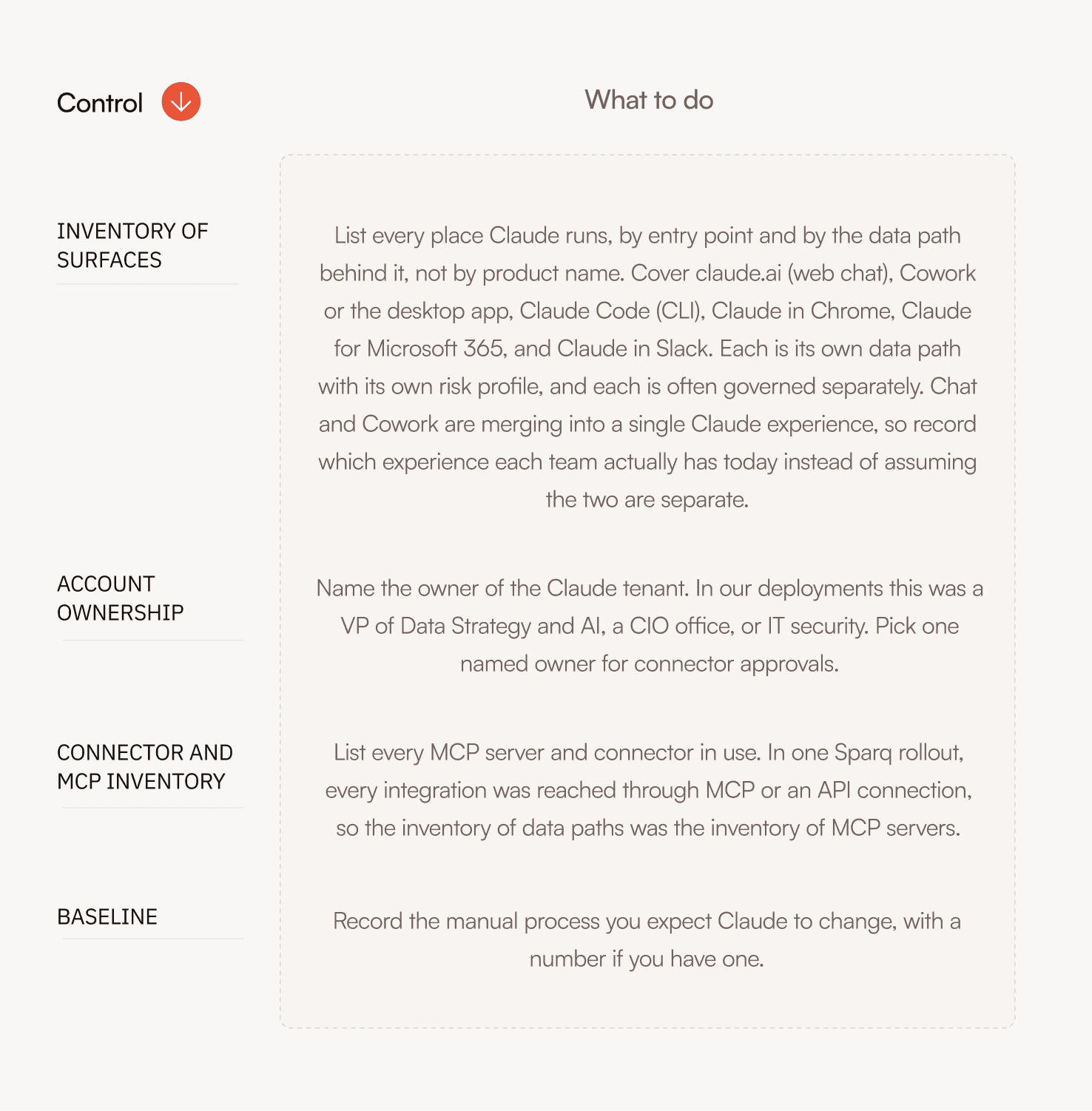
If your tenant is moving to the unified Claude experience: On Enterprise plans, the merged chat and Cowork experience is a beta that admins turn on, for the whole organization or by role. Nothing changes until an admin enables it. SSO and SCIM settings carry over, and connector policies still apply. Treat it like any other rollout. Turn it on for a pilot role first, check egress, connector and sharing settings, then widen in waves.
- Claude in Chrome (browser sessions and the sites a user is signed into)
- Claude for Microsoft 365 (Outlook, Word, Excel, SharePoint content reachable under the user's Microsoft identity)
- Claude in Slack (channel and message content, which ties to the Slack concern raised in Phase 2)
Example from our work: A customer experience management company started with a self-serve download inside Marketing and later had IT take over provisioning through Jamf. Because Cowork and claude.ai ran side by side, the delivery team could not split time savings by surface. Decide up front whether you need that split. The same question applies to any merged chat and Cowork experience.
Phase 2: Implement governance
Goal: Identity, connector permissions, spend, and audit in place before the user base widens.
Identity
- SSO first. The customer experience company moved from email invites to Google Workspace SSO within about six months so access could be managed and audited. Add SCIM group provisioning when Claude spreads beyond one department.
- Delegated identity for data access. In the private equity deployment, every call ran under the user's own Microsoft Entra identity through delegated OAuth, with no service account and no elevation. A user could reach only what they could already open in SharePoint.
- Group-based roles. The fire protection manufacturer mapped an Entra group to a clientcode-user role and gave everyone else clientcode-noaccess. Provisioning ran through the existing IT ticketing system.
Connector and MCP permissions
- Start read-only, then add write. The private equity pilot began with read-only SharePoint retrieval. Only after it was validated end to end did Phase 2 add Outlook, controlled SharePoint write with deletes blocked, and a read-only Databricks server. The reasoning: a retrieval mistake is a wrong answer, a write mistake is a changed record.
- Route everything through one control point. That deployment sent Cowork through a Bifrost MCP gateway and a custom Microsoft Graph MCP server, with all calls logged to Azure Log Analytics. Governance was packaged once and reused by each new connector.
- Put a change-control policy on new servers. The restoration contractor limited Claude Code to one MCP server (a local server over documentation) and adopted a change-control policy for adding more.
- Expect security review to set your pace. Security reviewed each new connection, and not every request was approved.
Claude Code controls
- Managed settings. In the fire protection and Bedrock-based deployments, a managed-settings.json enforced the model allowlist, and settings plus initial CLAUDE.md files were written into each developer environment at build time.
- Layered access. The restoration contractor used four layers: a filesystem boundary limiting writes to two directory trees with denies evaluated before allows and subprocesses in an OS-level sandbox; a command policy that allows reading and denies mutating commands; per-occasion grants for production and vendor systems; and write-tool denial on systems of record.
- Role guard hook. A hook blocked the implementer role from editing the records that define what to build and why, so a disagreement had to be recorded instead of silently overridden.
- Guardrails on every call. The fire protection manufacturer applied Bedrock Guardrails with prompt-attack filtering at high strength, content filters at medium strength, and custom patterns that block secrets and keys.
Spend and usage
See the cost section below.
Audit and data retention
- Log every tool call under a real identity. The private equity deployment logged to Azure Log Analytics with 30-day retention. The fire protection manufacturer wrote model invocation logs to a versioned S3 bucket with a seven-year lifecycle.
- If Claude Code runs through Bedrock, your audit record for that surface lives on the AWS side (CloudTrail and model invocation logging), not in the Claude Enterprise tenant.
- Check retention and compliance per surface, not per vendor. Anthropic holds SOC 2 Type I and Type II, ISO 27001 and ISO/IEC 42001, with reports available through its Trust Portal. Zero data retention is available for eligible API use and for Claude Code on Enterprise plans. HIPAA coverage comes through a BAA on a HIPAA ready Enterprise plan, and it goes feature by feature. Connectors, Claude in Chrome and skills are not covered. Anthropic’s BAA also doesn’t cover Claude Code through Bedrock, so check your cloud provider’s terms for that path. Confirm against your own plan before any regulated data goes in.
Phase 3: Move to production
Goal: Prove the workflow is safe and repeatable under real conditions before you widen access.
- Sandbox first. In one financial services deployment, each phase was built and validated in a Sparq sandbox, then promoted into the client’s tenant. Nothing untested touched live data. Promotion had three gates. Permission boundaries were tested so no user could reach more through Claude than they already could. A small test group validated the workflow and signed it off. And the install procedure was proven on a test machine before IT rolled it out.
- Staged user groups. The fire protection manufacturer ran an alpha pilot of 20 developers. Reviewer feedback changed the documentation and the token limits before rollout. Today 25 developers have access and 18 actively use it, with 80 to 100 planned through Q1 2027.
- Workflow design. The restoration contractor's intended workflow was "fill in a form, hand it to Claude Code, review the output," with forms for intake, events, and architecture decisions.
- Keep deployment authority out of the agent. On that estate, Claude Code writes code and infrastructure definitions, and the existing pipelines deploy them. No agent has deployment authority.
- Package for handover. The private equity build was packaged as infrastructure as code with an IT runbook so the client can redeploy without Sparq.
- Plan for platform friction. Examples we hit: an OWASP web application firewall rule blocked the redirect URI used for Claude's OAuth dynamic client registration (fixed with a scoped exclusion), and a third-party AWS administrator had not completed the one time Anthropic model setup in Bedrock, which blocked model access for two weeks until the client redeployed into a secondary environment.
Phase 4: Scale and optimize
Goal: Multi-team rollout, cost control, and reporting leadership trusts.
- Sequence by group. The fire protection rollout was sequenced by team to tune budget caps and decide where to expand. Usage differed meaningfully: ecommerce teams used about 60% more than the IoT team.
- Bind adoption to existing process. Sparq's own Cowork skills attach to steps in a methodology people already had to follow, and install with a single command. No one has to decide to adopt Claude.
- Use leadership and live demos. At the customer experience company, a live dashboard-building demo drew more attendees than regular office hours, and a CMO mandate produced a usage jump.
Cost and ROI
Spend controls we have seen work
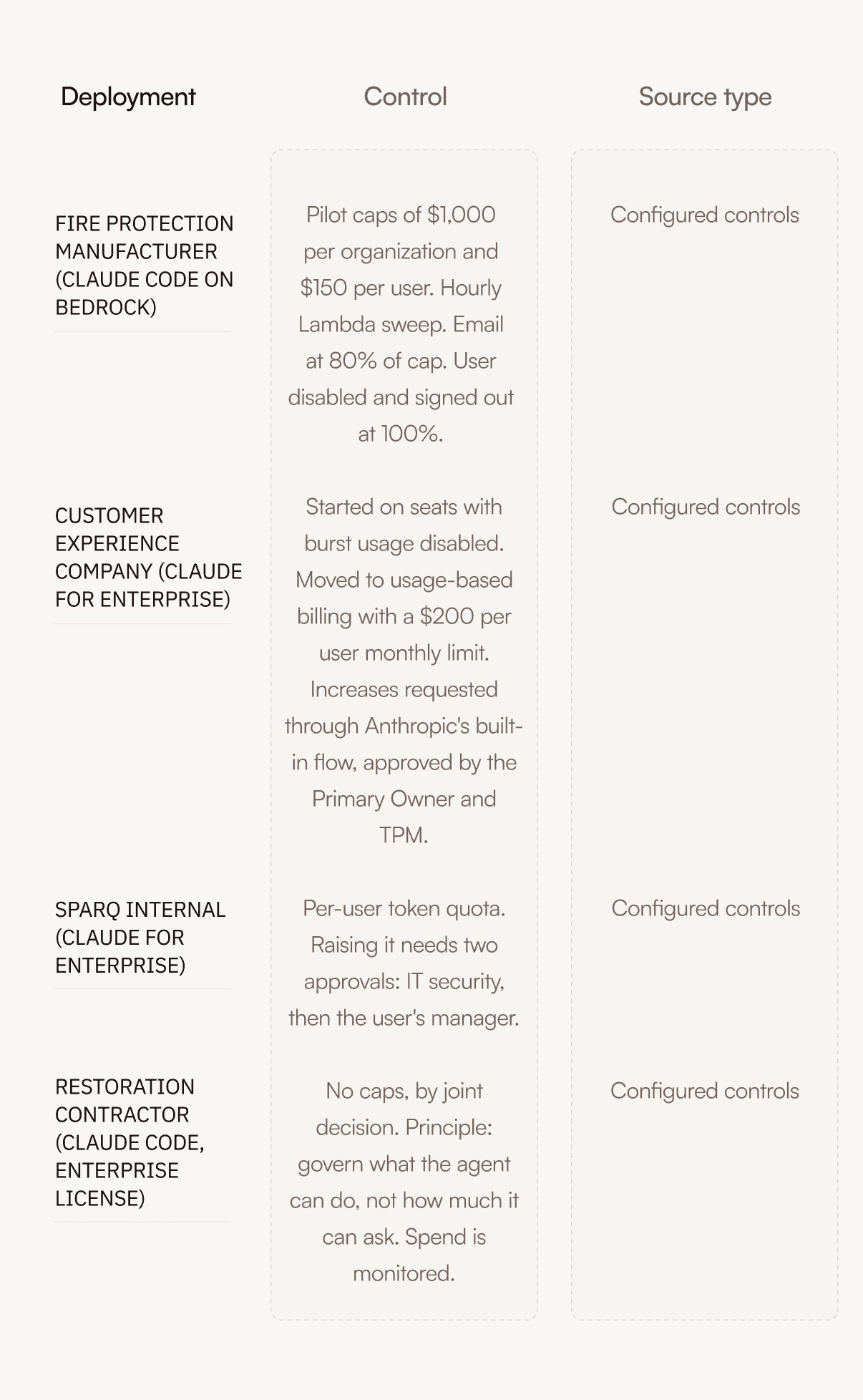
A measured cost data point
One heavy use Claude Code seat we’ve seen ran close to $3,000 a month. That’s one engineer, not a seat average.
List prices change, so check claude.com/pricing before you budget. As of October 2026, Team seats are $20 per seat per month billed annually, or $100 for premium seats. Self serve Enterprise is $20 per seat per month plus usage billed at API rates. The API bills per token by model.
Measuring value tied to the workflow
Label every number by how it was obtained.
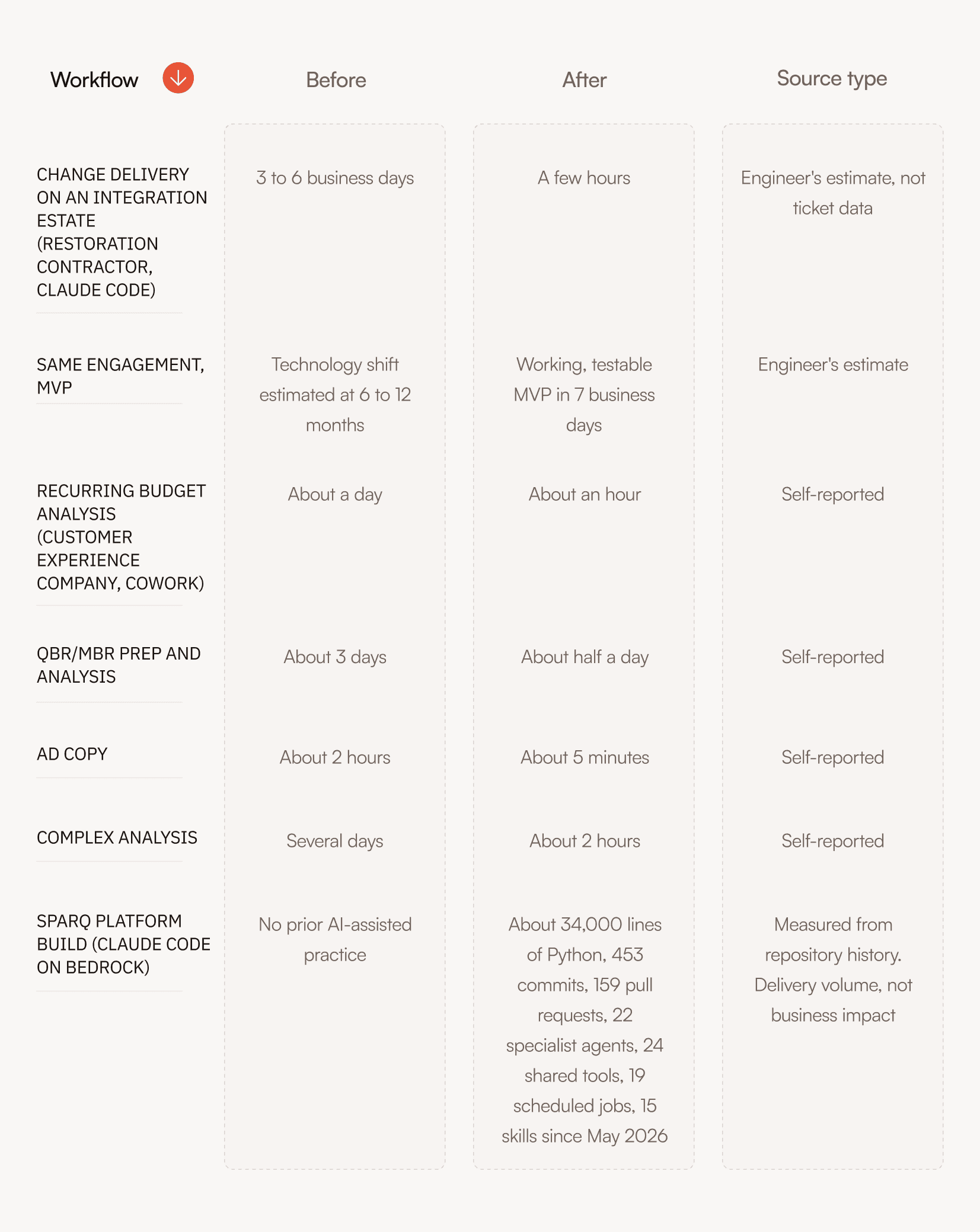
Framework: pick the workflow Claude replaces, record the baseline before launch, pull usage from the admin console, and report the after-figure with its source type. Sparq's own sales-prep workflow has a written 3 to 4 hour baseline per client interaction and no measured after-figure yet, which is why we recommend capturing this at launch.
FAQ
Top Governance Questions
Learn more.
With 15+ years of experience spanning software engineering and product leadership across healthcare, fintech, and security, Phil specializes in turning AI ambition into high-impact, production-ready software. As a Principal Consultant at Sparq, he sits at the intersection of product strategy and hands-on execution, building AI tools and client assets daily with Claude Code while leading internal upskilling initiatives.
Related