Data governance enables trustworthy AI at scale
AI at scale amplifies every data quality, access, and lineage gap. See the production controls that keep AI trustworthy and fast.

In production AI, governance is a set of running controls with owners, thresholds, and evidence. This guide shows what those controls look like.
A pilot can run on messy data because a person is watching it. A production system has no one watching. When AI runs at scale, one stale feed, one undocumented access path, or one broken transformation repeats across every decision the system makes. It happens all day, and nobody notices until a customer, an auditor, or a P&L shows the damage.
That is why governance changes character once AI goes live. It stops being a documentation exercise and becomes a set of running controls. Quality gates stop bad data. Escalation paths name an owner. Lineage lets you explain any decision after the fact. Industry analysts agree on what is at stake. Gartner projects that by 2027, 60% of organizations will fail to realize anticipated AI value because of incohesive data governance frameworks.
This guide covers what breaks first and how governance works as a production system. It also explains why teams with governed data ship AI faster.
Why does data governance matter more once AI runs at scale?
Scale repeats every data error across every decision, and it makes auditability a condition for staying in production. A person reviewing ten outputs a day will catch a bad number. A system making ten thousand decisions an hour will not. Governance has to move from a policy document into a runtime control.
Most governance content describes the program, meaning roles, maturity stages, and board priorities. Those matter, and our companion piece on turning AI policy into enforcement covers that layer. This guide describes the runtime. It covers what happens when a feed breaks at 2 a.m.
What are the three failure modes enterprises hit first?
Each failure mode below gets the same treatment. We describe what happens, what it costs, and the control that prevents it.
Failure mode 1: models running on stale data
An upstream feed misses a refresh. The model keeps scoring against last week's values because nothing tells it otherwise. Picture a logistics routing model that keeps using a rate table that changed on Monday. By Thursday, loads are being quoted below cost.
The cost is the number of quotes issued, multiplied by the average margin gap, multiplied by the days the problem went undetected. Plug in your own volumes. The result is usually larger than the cost of the gate that would have stopped it.
The control is a freshness SLA on every model input. An automated gate blocks scoring whenever the SLA is missed.
Failure mode 2: audit requests that stall AI in production
Compliance asks where a decision came from, and no one can reconstruct the inputs. The system is paused while people investigate by hand. Picture a lender whose automated decisioning is suspended during a regulatory exam because the team cannot show which data version fed a set of denied applications.
The cost is the weeks paused multiplied by the revenue per week the system supports, plus the hours spent investigating. The control is lineage captured automatically from source to decision. With lineage in place, evidence is a query and the audit never becomes a project.
Failure mode 3: teams that cannot reproduce a model decision
A customer disputes an outcome. Without versioned data and logged inputs, the team cannot explain or defend it.
The cost is the number of disputes per month multiplied by the cost to resolve each one. Add the write-offs from decisions that cannot be defended. The control is versioned inputs and decision logs, retained to a defined policy.
How does governance work as a production system?
Monitoring: quality gates before the model
Define gates for each data product, since each product has its own failure patterns. This starting set works for most use cases.
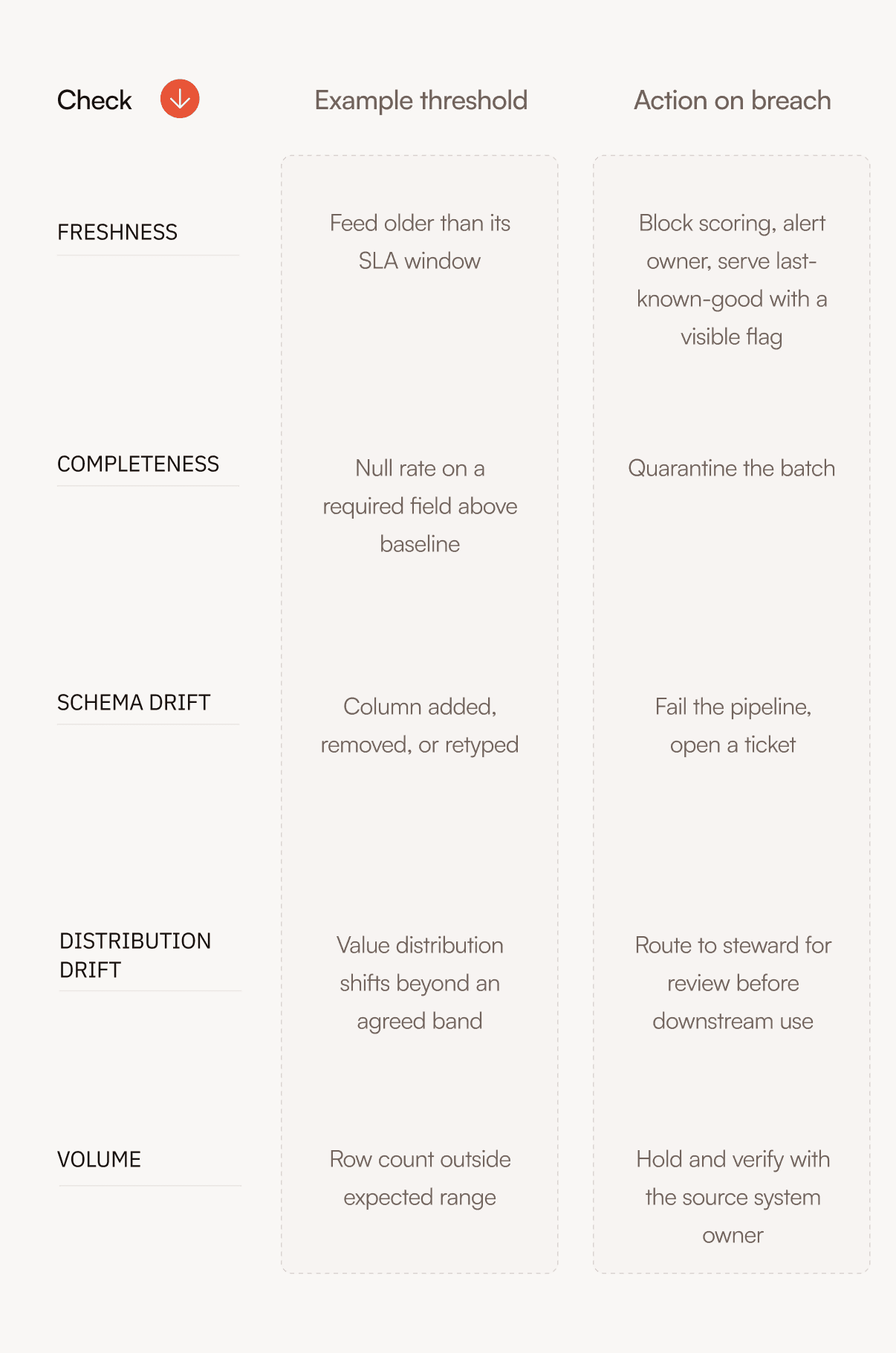
Set thresholds with the business owner of the data. Engineering should be involved, but the business owner knows what a bad value costs. PwC notes that machine learning can learn the normal distribution of a field and flag anomalies, so humans decide where the alert line sits. That pattern works well. The system proposes baselines, and people own the thresholds.
Exception handling: who gets called when something happens and the next steps
Write the escalation path before the first incident. A workable path has five steps.
- Automated detection raises an event with context: dataset, rule, severity, and affected models.
- A named data steward triages within a defined window.
- If the SLA is breached, the data owner is paged and downstream consumers are notified automatically.
- The team decides in advance on a degraded mode. The options are to pause, fall back to last-known-good, or route cases to humans.
- The team closes the loop with a root cause, a fix, and a new or tightened rule.
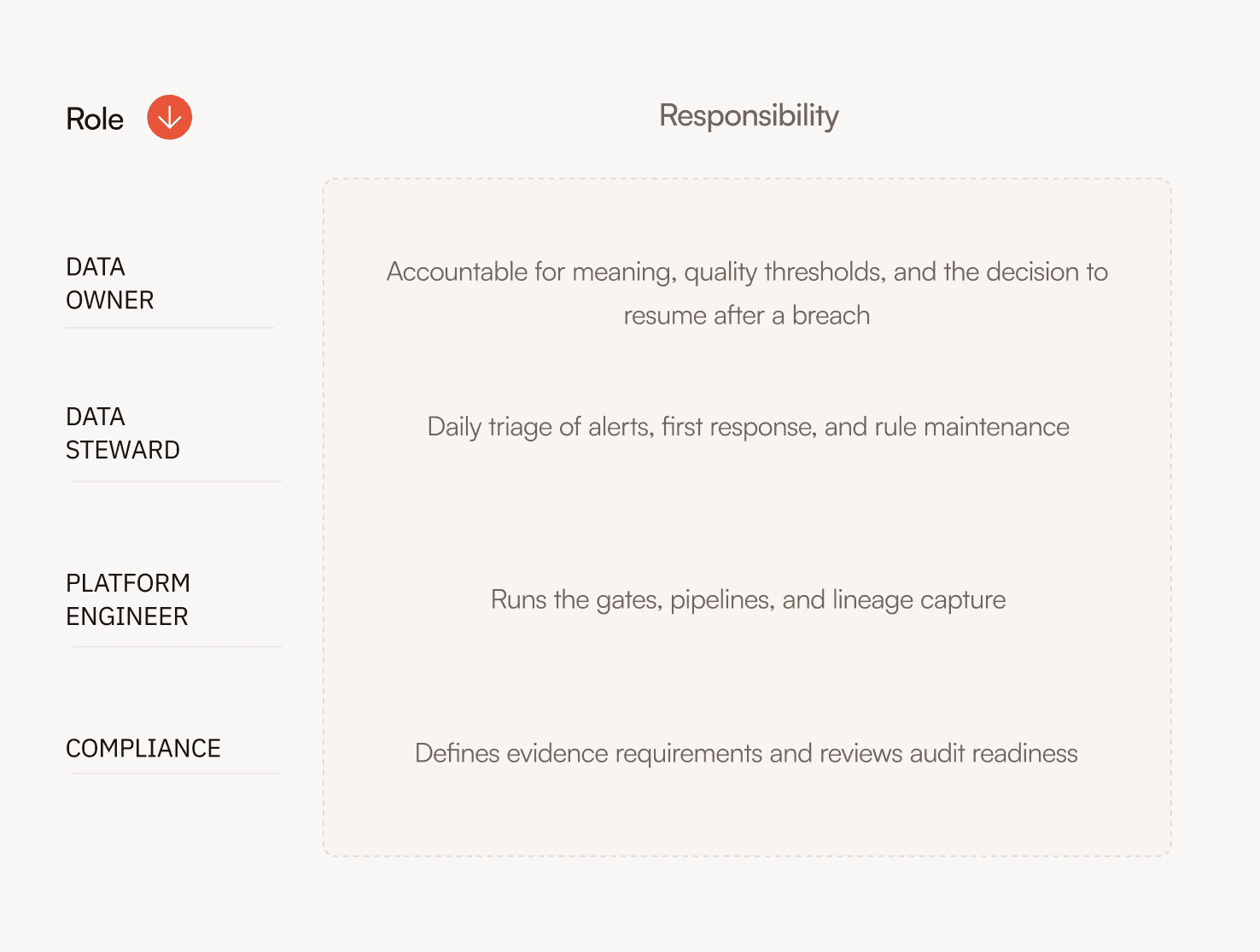
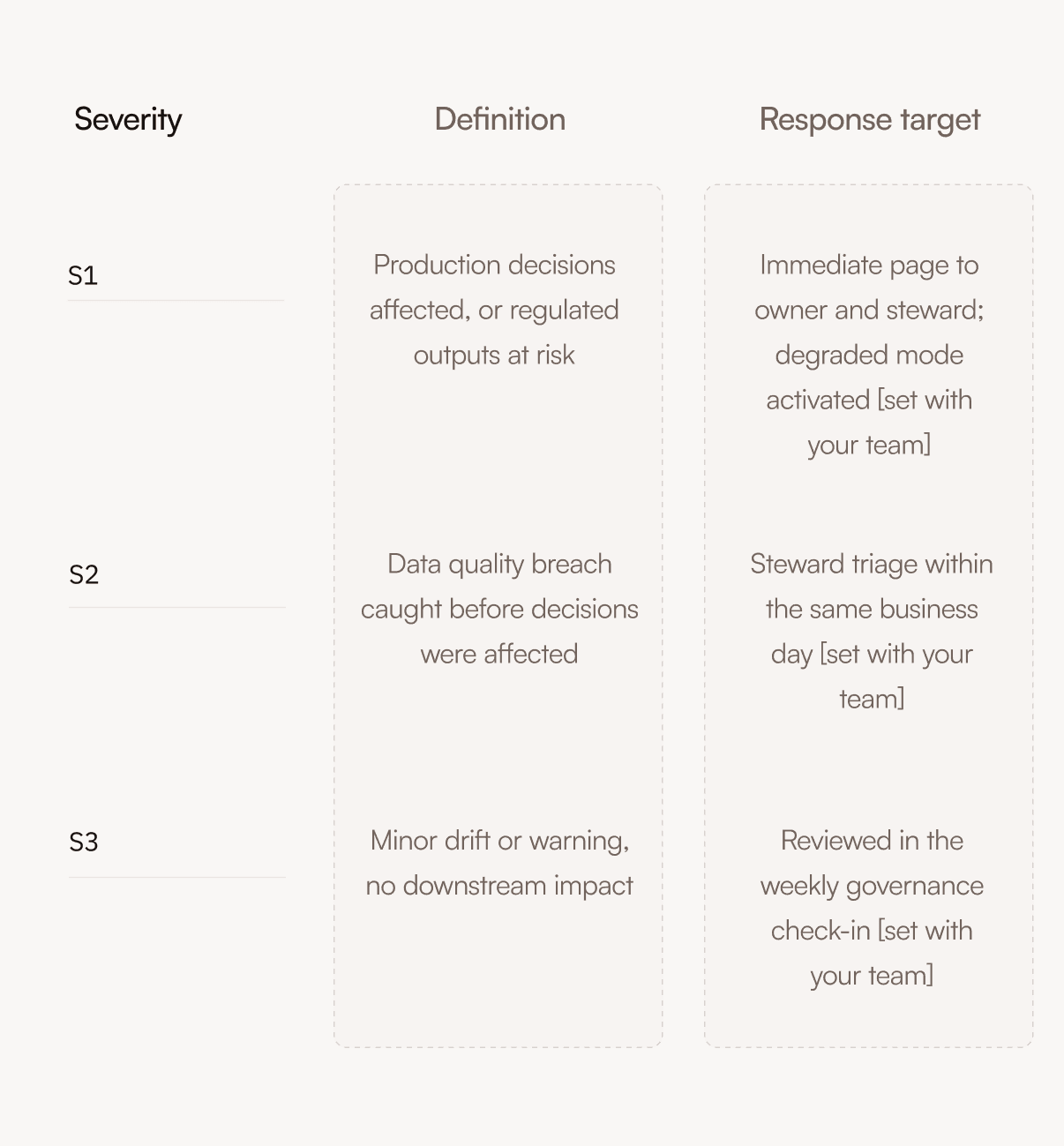
Governance fails when ownership is unclear and tooling is deployed without a workflow. The following two tables make ownership concrete.
Auditability: lineage from decision back to source
Turn every item an auditor will ask for into a query. Four questions cover most requests.
- Which model version and which data versions produced this decision?
- What transformations touched the data, and who approved the rules?
- Who or what accessed the data, and under which role?
- What a human reviewed or overrode, and when?
One more point matters as AI agents begin querying data continuously. Each agent should have its own access definition rather than inheriting a human analyst's role. Every interaction should be logged. Our write-up on building a Snowflake estate for agents covers the semantic layer and role-level access behind this.
Pattern cards: make each control repeatable
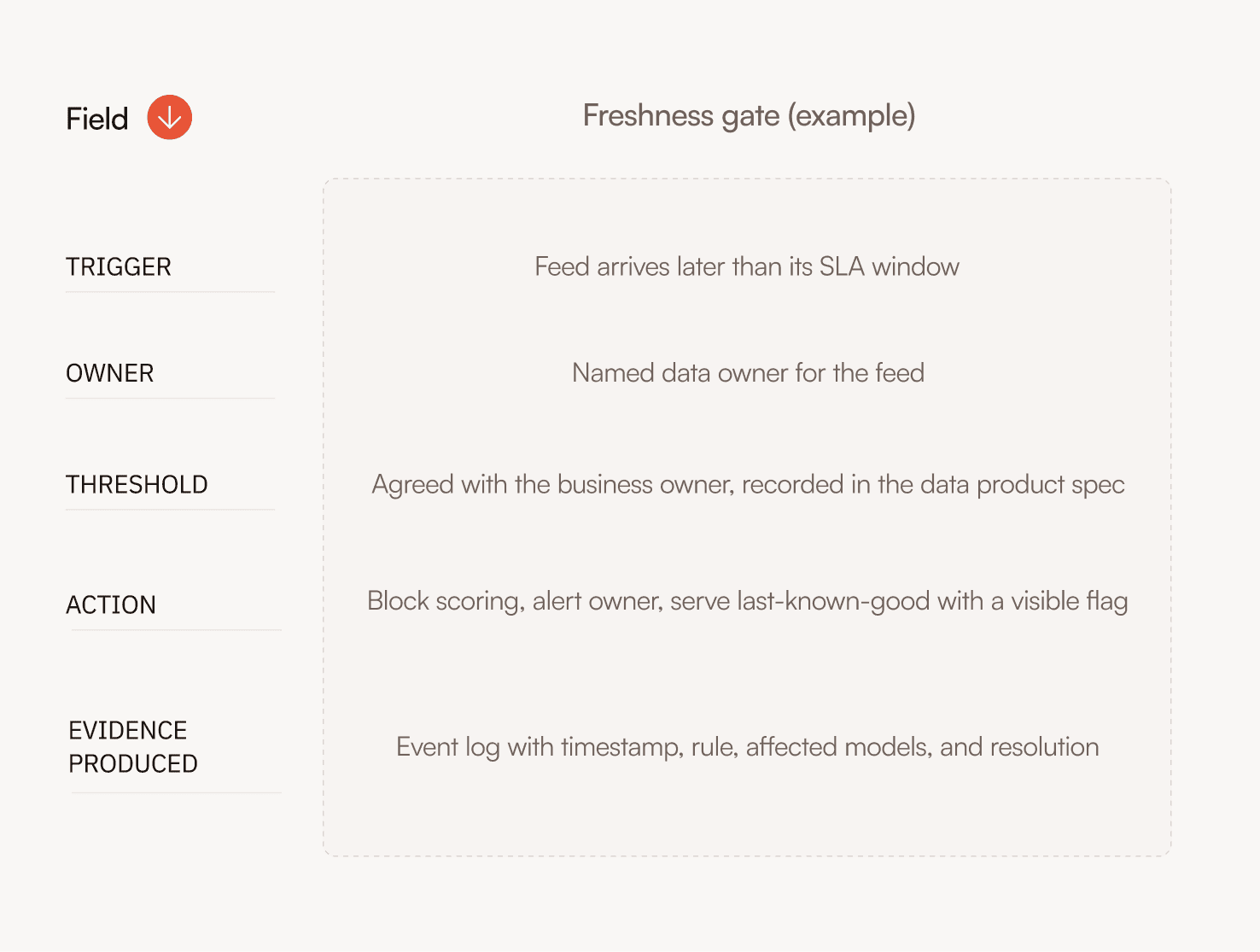
Document each control on a single card with the same five fields. Teams can then copy the format for every new data product.
What does governed AI look like in real builds?
Examples that come from Sparq work:
Example A: governed validation at intake (financial institution, mortgage origination)
Specialists manually reviewed bank statements for every application. Validation took hours per file, and that capped throughput.
Sparq embedded Verify.IQ in the existing ingestion pipeline. It extracts data, runs validation checks, and flags anomalies with explainable reasons. Clean files pass automatically. Exceptions route to specialists with full context.
The governance mapping is direct. Validation is the quality gate. The exception queue is the escalation path. Consistent, auditable outputs are the evidence trail. Compliance controls were preserved.
The published result was validation time cut from hours to 8 seconds, at $0.02 per document. That is a 99% reduction in processing time and cost, with no rip-and-replace. Read the mortgage validation case study for the details. Governance is what made automation acceptable to a regulated lender, and it did not slow the work down.
Example B: governed natural-language access to Snowflake data (global identity leader)
The client had hundreds of governed reports in Snowflake, but insight delivery was pull-based. Revenue teams assembled churn and health signals by hand.
Ask.IQ translates natural-language questions into governed Snowflake queries. It uses a semantic layer to map business terms to data models. It also captures every interaction in a feedback loop.
Each piece maps to a governance control. The semantic layer provides shared definitions. Role-based access decides who sees what. Answers are traceable, and a log shows what people actually ask. The result of our engagement with this client was 40+ use cases identified and 100% of user questions captured in the feedback loop. The semantic layer was the unlock.
Example C: a governed workflow in production in under 20 days (insurtech company)
Analysts translated policy documents into Jira tickets by hand, which slowed engineering and QA. Sparq adapted an AI accelerator to the client's workflow and integrated it into existing tools. Analysts stayed in place for exception handling and review.
The outcome was a 90% reduction in ticket-creation time and a production-ready system in under 20 days. Human-in-the-loop exception handling and a defined review path made that speed safe. This is a workflow automation result, so we offer it as an example of governed speed and make no claim that it was a data governance program.
Does governance slow AI delivery?
Not when it is built into the workflow. Reusable definitions, certified data, and automated evidence remove the rework that otherwise slows each project.
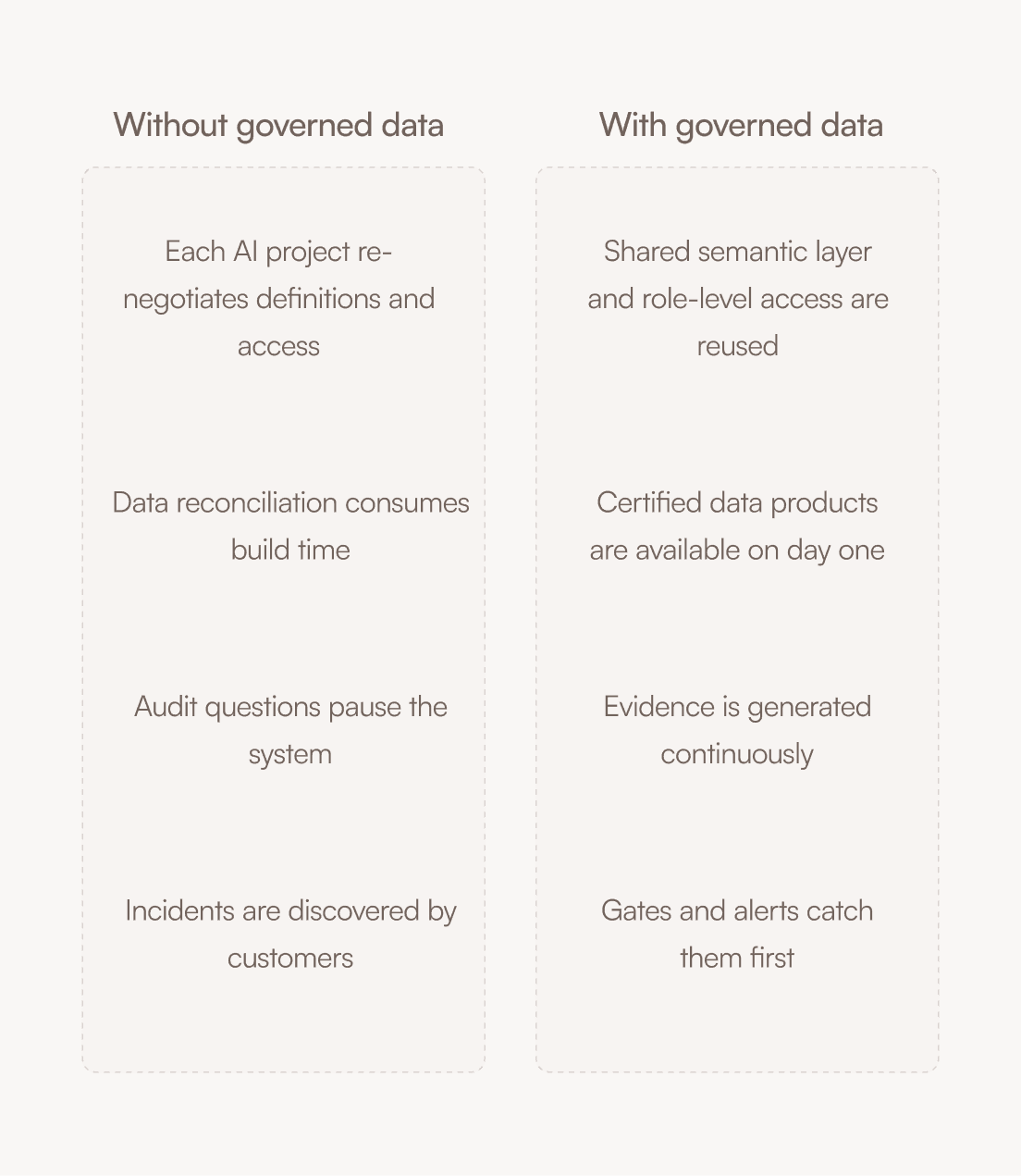
Our Intelligence Studio accelerators (Ask.IQ, Verify.IQ, and Assert.IQ) are built to make governance operational inside existing systems. The 90-day path below shows that governance and speed work together. The problem every company has been avoiding is usually the data nobody owns, and we're into that.
What is a practical 90-day plan to start?
Scope to one AI use case first. This plan stands up production governance for that single use case in 90 days.
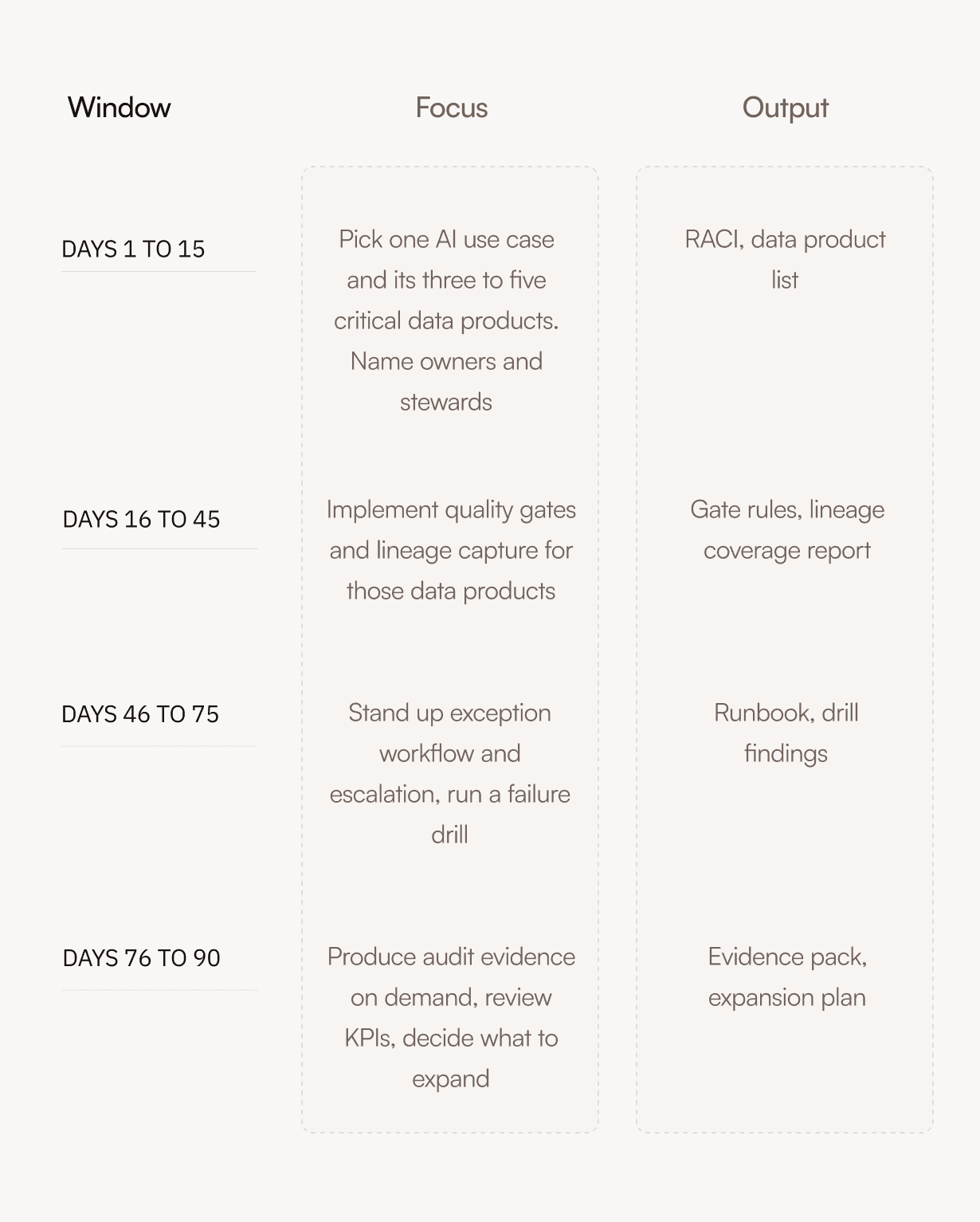
- Track five KPIs.
- Percent of model inputs under a freshness SLA
- Mean time to detect and resolve data incidents
- Lineage coverage of production decisions
- Time to answer an audit request
- Number of AI releases blocked by data issues
Production AI governance readiness checklist
Use this checklist to test one use case:
- Every production model input has a named owner and a freshness SLA
- Gates exist for freshness, completeness, schema, and drift
- A written escalation path and degraded mode exist for each critical data product
- Any decision can be traced to model version, data version, and access role
- AI agents have their own access permissions and logged activity
- Audit evidence can be produced in days, not weeks
- Thresholds were agreed with business owners
- A failure drill ran in the last 90 days
If your AI is moving from pilot to production and the data underneath has no owner, talk to Sparq about a governed starting point.
FAQ
Frequently Asked Questions
Learn more.
Sparq is an AI-native digital engineering firm that re-engineers the systems businesses run on, turning operational bottlenecks into margin, throughput, and decision speed. Our work spans legacy modernization, connected data and AI, workflow optimization, and production-ready agentic systems that execute decisions inside governed guardrails. Headquartered in Atlanta, Georgia, and with senior-led delivery teams across the U.S. and Latin America, Sparq serves Fortune 1000 and enterprise clients across industries, including transportation & logistics, real estate & construction, and financial services & insurance.
Related