When the Deal Closes, the Data Problem Starts
Post-merger data integration is a familiar issue post-M&A. The systems don’t align correctly, and the data doesn’t fully match, so no one trusts the reporting. This post breaks down where and why post-merger data integration typically breaks, and what a more stable foundation looks like.

When the deal closes, it can feel like everything should just slot together. After all, the integration plan shows a single organization with a unified operating model and a shared set of goals.
What’s often overlooked is the data underneath it all. It’s not a primary focus during deal planning, so the complexity only becomes visible later. Post-merger data integration issues tend to surface during day-to-day execution, and once they do, they appear quickly.
The issue is rarely that either legacy system is broken. The trouble starts when both systems have to support a single set of reports, a single forecast, and a single operating plan, even though they still define customers, revenue, products, and timing differently.
How Post-Merger Data Integration Breaks Down in Day-to-Day Operations
The idea that IT can be figured out once the deal is done no longer holds up, and technology integration is now a known driver of M&A underperformance. Research from Kearney shows that 80% of value-destructive deals lacked a technology integration plan at signing, highlighting how often integration risks are still underestimated at the deal stage.
Integration can start to break down in practice long before it shows up in formal reporting. The issues may start small, but they can spread quickly once teams depend on shared reporting. For example, one organization may record “revenue” as soon as a deal is signed or an invoice is issued, while the other records it only once the customer has paid. Combining these two organizations means the numbers don’t align cleanly, so reports differ depending on which system is used, and forecasts become less stable because revenue timing is inconsistent. It creates confusion, and finance teams waste hours reconciling the differences.
In another scenario, one system might update sales numbers in real time, while the other lags behind. Teams may pull the numbers into one report and still end up with an outdated view. Performance shifts become harder to catch, and decision-making slows.
Even simple things like product or customer naming can become issues. The same customer might exist in both organizations’ systems under different IDs or slightly different names, fragmenting their activity data. Similarly, the same product might be structured differently because each organization uses its own system. Instead of one clean, unified view, you end up with a duplicated and inconsistent dataset. Over time, these delays add up.
The Financial Impact of Using AI After Acquisition
Many deals are heavily reliant on future efficiency and growth, which increasingly depend on AI. As a result, AI has become a central theme in M&A activity, influencing capital allocation decisions and accelerating investment in data and talent. The scale of AI also adds pressure to deal strategy, with some estimates showing that between $5 trillion and $8 trillion will be required over the next 5 years to build AI infrastructure and capabilities (for context, global M&A values in 2025 totaled just $3.5 trillion), according to research by PwC.
However, AI is also making execution more complex. Adoption has climbed from 78% of organizations to 88% in one year. Most companies, though, are still experimenting, piloting, or narrowing their use cases. Only about one-third have scaled AI across the enterprise. Adoption is moving faster than the structure needed to support it.
Post-M&A, an inconsistent data foundation turns AI integration into a significant financial risk. Conflicting definitions and reporting logic make data harder to manage, causing forecasts to take longer to trust and close cycles to rely on manual reconciliation. Synergy targets also become harder to measure because each business may still define customers, revenue, products, or margin differently.
This friction affects everyday decisions, including these examples:
- For manufacturing companies, it can mean production plans are based on demand data that doesn’t fully match across sites. One plant may overproduce while another runs short because each site is working from a different demand signal.
- For financial services companies, inconsistent definitions of customers and revenue can create a distorted view of performance. That makes it harder to see what’s actually working, meaning capital may end up being allocated in the wrong places.
Over time, these small inconsistencies and technical debt build up, preventing key AI initiatives, such as forecasting and automation, from scaling beyond pilots. The longer it takes to fix these issues, the more complex and expensive it ultimately becomes.
M&A Data Consolidation: The Path Forward
What separates organizations that recover quickly from those that stay stuck is how they approach these post-acquisition operational challenges. Those that succeed treat M&A data consolidation as something that needs clear ownership and structure from the very beginning, rather than just an IT backlog.
These efforts typically include:
- Clear governance: With defined ownership of data and decision-making, the combined organization uses a single set of definitions rather than multiple versions of the truth. Sparq’s M&A Synergy & Integration work supports this kind of governance by helping teams clarify who owns key decisions, which definitions need to align first, and how integration work should move across the business.
- Delivery sequencing: Prioritize areas, such as customers and revenue, instead of trying to fix everything at once. That means the organization can keep moving as it should while integration work progresses. It also helps protect ongoing programs from stalling while the highest-risk data issues are addressed first.
- Integration execution: The work has to be managed across teams and systems as problems appear, not after they have already slowed the business down. Sparq’s Control Tower model helps create structure when teams are dealing with inconsistent data, delayed workstreams, and unclear ownership.
- Building a usable data foundation: Align systems and data flows so the organization has a single, consistent view of core operations. Sparq’s PPM capabilities can help leaders see where integration risk is affecting the broader portfolio, including the programs that depend on reliable customer, revenue, product, and margin data.
In one post-acquisition engagement, Sparq supported a $5B organization through a $1.3B acquisition involving strict transition-service requirements and cross-selling deadlines. The work helped protect execution during integration, resulting in 100% TSA execution and 7% revenue growth in the acquired service line.
When these elements come together, integration shifts from bolting systems together to helping the combined organizations operate as a single, connected business. Reporting becomes more reliable, and there’s a stable foundation for AI to scale and support more informed decisions.
Where to Go From Here: Download the Companion Checklist
Most organizations realize how complex post-merger data integration is only once they start operating on combined data, when execution problems begin to surface.
Execution and recovery models are designed to help plug these gaps by bringing structure to fragmented systems, enabling separate organizations to operate as a connected entity.
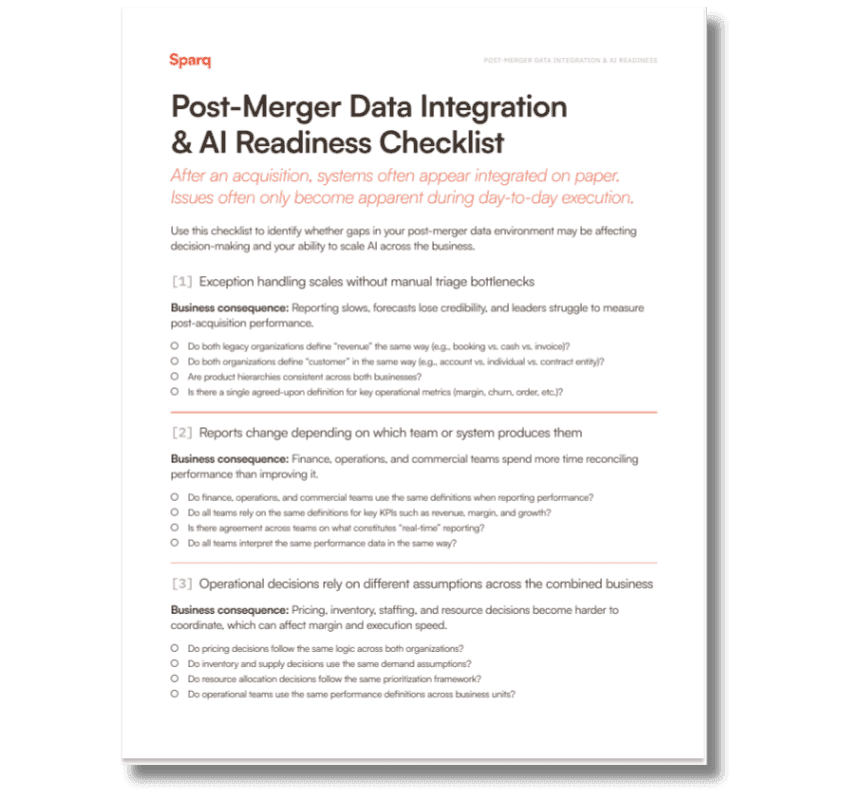
The next step is to get clarity on how consistent your data is across your systems and teams right now. To help you out, we’ve created a companion checklist to surface where post-merger data integration gaps may still exist, and how they may already be impacting reporting and decision-making across your organization.
If you want to understand whether your current setup supports or limits M&A data consolidation, this is a good place to start.
Sparq is an economic performance engineering partner, built for the age of AI. We re-engineer the core systems businesses run on, turning manual bottlenecks into measurable margin, throughput, and decision speed. Trusted by clients across industries, including transportation & logistics, real estate & construction, and financial services & insurance.
Related