Legacy Modernization Without Downtime: Phased Approach
Sparq's legacy modernization is a phased, parallel-run approach that re-engineers operational systems into API-first, modular platforms while the business keeps running. Unlike a one-time migration, it builds the architecture AI-driven operations need after go-live.

Most modernization programs are funded because the business is forced to. A product or platform the system depends on is no longer supported, and staying put stops being an option. That mandate gets the budget approved, but it does not define success. Operations and technology leaders still need the project restated as a number that moves: lead time, cost to serve, margin per unit. If it cannot be restated that way, it will be defended as a replacement cost forever. The three engagements below show the number that moved, the bottleneck that was removed, and the mechanism that removed it.
Leading conveyor systems manufacturer — Manual analysis gated every lead-time commitment
Bottleneck: Teams ran manual data analysis before committing a lead time. Every quote and schedule waited on that analysis.
What Sparq re-engineered: Wired the source data into a governed operational layer and automated the analysis step so the answer arrives with the request, not weeks after it.
Metrics:
- 95% reduction in manual data-analysis time
- 75% workforce cost savings
- Lead times cut from six weeks to days
Outcome in the buyer's terms: A lead time measured in days instead of six weeks, delivered by a smaller cost base.
Cerbo — A production codebase too heavy to change safely
Bottleneck: Years of accumulated production files made every change slow to scope, slow to test, and risky to ship. Modernization scope was stalling before it started.
What Sparq re-engineered: Surfaced what the platform actually depended on, deleted what it did not, and delivered scope in increments under live conditions rather than waiting for a single release.
Metrics:
- 35% of total modernization scope delivered in the first three months
- 54,000 production files deleted
Outcome in the buyer's terms: More than a third of the modernization landed in a quarter, a more maintainable platform with a flexible architecture that is easier to evolve
Learn more about using AI to compress modernization from years to months →
Global provider of transportation and mobility solutions — Resale decisions made on stale, disconnected data
Bottleneck: Fleet resale timing and pricing were decided without the connected data needed to optimize each vehicle's exit. Every vehicle sold below its optimal value was margin left on the lot.
What Sparq re-engineered: Established the connected data layer first, then embedded an AI-driven decisioning engine into the resale workflow that operations already ran.
Metrics:
- $90M annual gross margin
- $50 - $100 incremental resale revenue per vehicle
Outcome in the buyer's terms: Every vehicle exits closer to its optimal price, and the aggregate shows up as annual gross margin.
Read the fleet resale decisioning result →
Three ways to modernize. Each one can be ready for AI.
The right modernization path depends on your constraints: how fast the current problem must go away, how much downtime you can absorb, and how well the existing logic is understood. The table states each path in those terms, along with how Sparq positions the modernized system to take advantage of AI automation under each one.
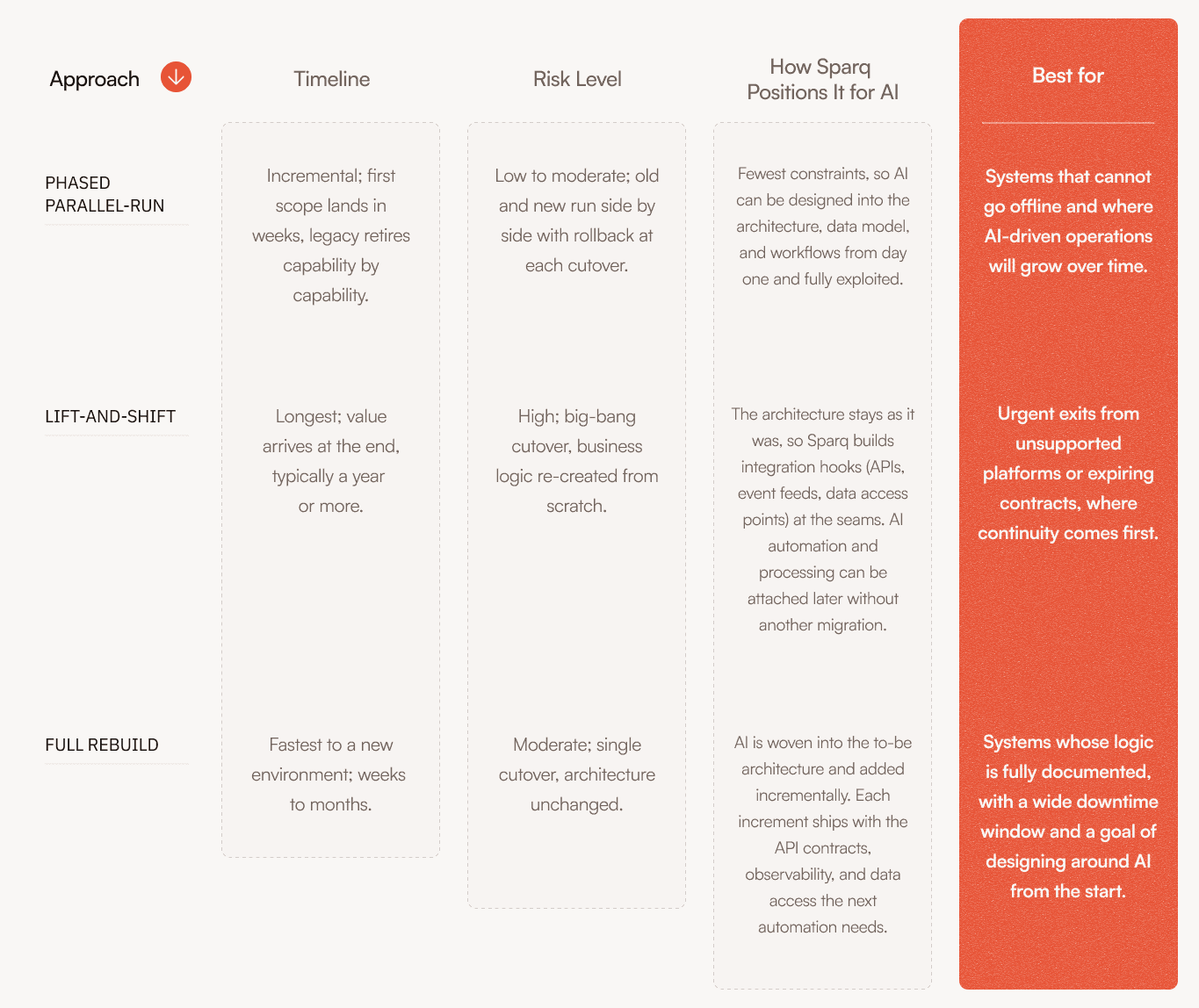
Whichever path fits your constraints, Sparq designs the modernized system to take advantage of AI: woven into the architecture incrementally, designed in from day one, or enabled through hooks added at the seams.
Modernization built for operational capability.
Operations and technology leaders approving a modernization program need to know what arrives, in what order, and what has to be true before the next phase starts. Each phase below closes with named outputs, not a status update. Legacy systems decay when the people extending them lack context: the original designers are gone, and developers layer redundant code on top rather than risk breaking what they do not understand. Sparq's AI-driven ADLC captures and maintains that context throughout, so your developers can interrogate the system with AI and extend it without adding debt.
1. Surface what cannot break
We identify the operational logic, dependencies, and workflows that the business cannot afford to lose before modernization begins.
What lands:
- Cannot-Break Register — the business rules, calculations, and approval paths that exist only in code, named and mapped to the workflow they protect
- Dependency and Integration Map — every upstream feed, downstream consumer, and batch window the system participates in
- Baseline Metrics Sheet — current processing time, manual-analysis hours, and throughput for the workflows in scope, so the improvement is measurable from day one
- Scope Liability Assessment — where a minimum-viable scope would create a future retrofit, scored against the seven diagnostic categories in the Agentic Readiness Business Case Builder
- System Context Library — the captured logic, dependencies, and design rationale of the existing system, held in a form your developers can query and interrogate with AI, so context no longer lives only in people's heads or in the code
The Cannot-Break Register and Dependency Map are produced with Blueprint.IQ, Sparq's platform for mapping the operational logic and dependencies hidden in legacy code.
When: Closes before any production code changes. Phase 2 does not begin until the Cannot-Break Register is signed off by the operational owner.
2. Re-architect what comes next
API-first systems, modular workflows, embedded observability, and operational flexibility built into the architecture from the start.
What lands:
- Target Architecture Blueprint — decoupled service boundaries, API contracts, and the operational data layer that downstream intelligence will read from
- Increment Sequence — the order in which capabilities move from legacy to modern, each with its own rollback condition
- Observability Spec — the telemetry, alerts, and dashboards that will prove each increment is behaving in production
- Parallel-Run Plan — which legacy and modern components run side by side, for how long, and what reconciliation confirms parity
When: Closes before the first production cutover. The Increment Sequence becomes the delivery plan the business tracks against.
3. Modernize inside live operations
We re-engineer systems under production conditions without disrupting the workflows the business depends on.
What lands:
- Working Increments in Production — each capability cut over on its own schedule, with legacy retired only after parity is confirmed
- Cutover and Rollback Log — a record of every cutover, its reconciliation result, and the rollback path that was available
- Live Metrics Readout — the Baseline Metrics Sheet re-measured after each increment: processing time, manual hours, throughput
- Decommission Record — what was deleted, when, and what the platform no longer depends on
- Living Documentation Update — the System Context Library and documentation refreshed after every increment, so what is documented always matches what is running
- Intelligence Embed Points — the workflows where the modernized data layer is now ready to carry embedded decisioning, so the next investment starts from a proven foundation rather than a business case
When: Runs increment by increment. The first working increment lands inside live operations rather than at the end of the program.
FAQ
Frequent Asked Questions
The most common concerns we've heard.
Sparq is an AI-native digital engineering firm that re-engineers the systems businesses run on, turning operational bottlenecks into margin, throughput, and decision speed. Our work spans legacy modernization, connected data and AI, workflow optimization, and production-ready agentic systems that execute decisions inside governed guardrails. Headquartered in Atlanta, Georgia, and with senior-led delivery teams across the U.S. and Latin America, Sparq serves Fortune 1000 and enterprise clients across industries, including transportation & logistics, real estate & construction, and financial services & insurance.