Legacy Modernization in 2026 vs. 2023: What Changes With AI Agents
AI agents cut legacy modernization discovery from months to weeks, surface hidden business rules early, and stretch budgets further than in 2023.

If you approved a modernization budget in 2023, you probably remember the estimate: 18 to 24 months to rebuild a system the business took a decade to grow. Many CIOs and COOs still carry that number into planning meetings. It no longer describes what a well-run project looks like. This article compares how legacy modernization worked in 2023 with how it works in 2026 across economics, speed, risk, and ongoing maintenance cost, and it names what AI agents have not changed.
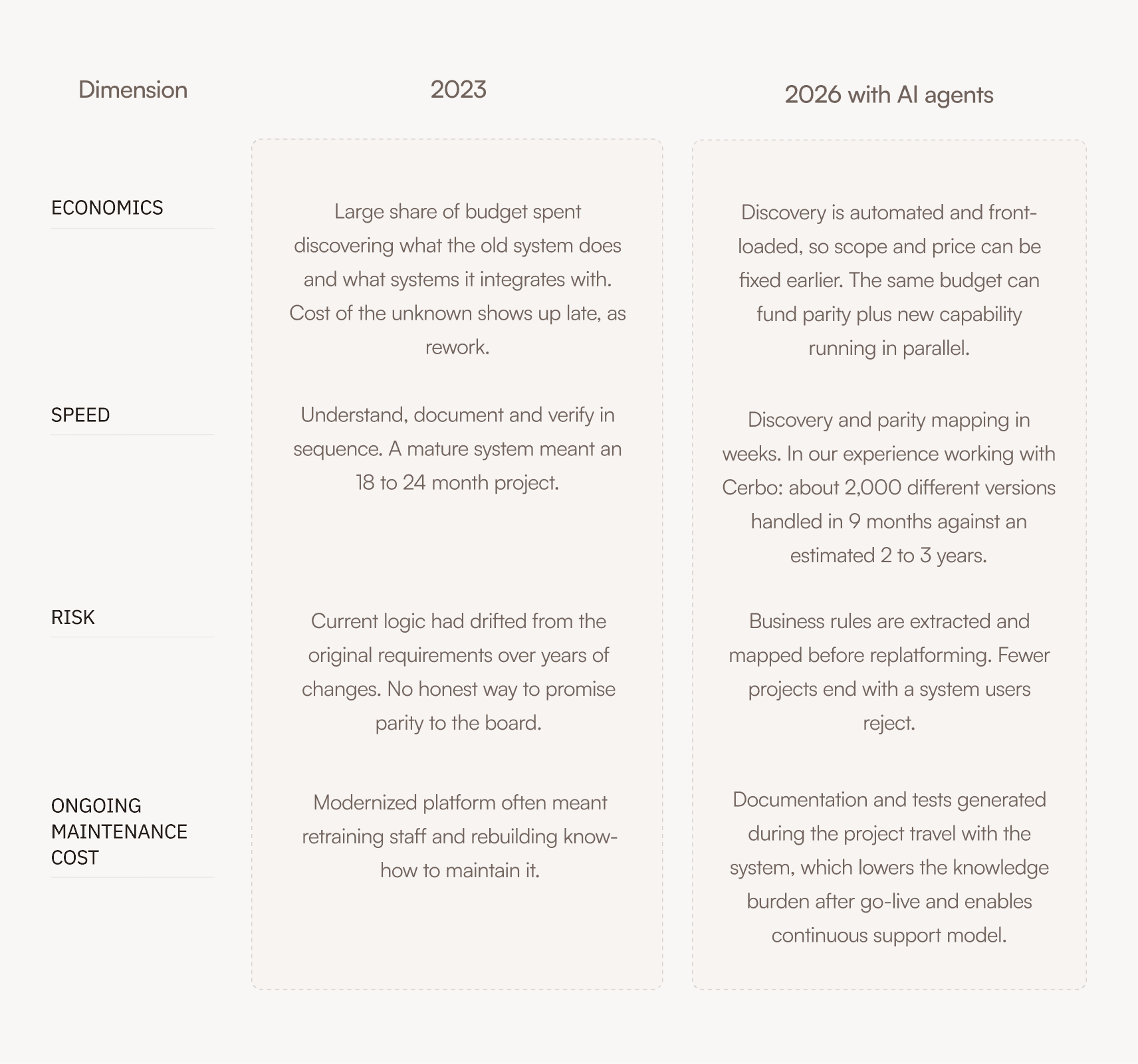
Then vs. now: 2023 and 2026 side by side
Speed: weeks of discovery, not months
The buyer's number: discovery and parity mapping now run in weeks. In 2023 the same work took months, and for a system with a long history it could take years of accumulated effort to fully understand.
The reason is mechanism, not hype. A mature system has usually been through decades of enhancements and changes, so what it does today often no longer matches the original requirements and documentation it was built from. In 2023 the team recovered that logic through interviews, performing exploratory and "monkey" testing. AI agents now read the platform at the system, component, container and code level, map each function to a business rule, and produce a parity map in human-readable language the delivery team and the business can review together.
The output of discovery is also reusable. The agent that reads the code writes down the business rules in a structured format that other agents can pick up directly. A second agent can plan the new design from it, a third can re-build the system based on the design and requirements, and fourth can generate tests and check the final result traceable to the original platform under modernization. Every step starts from the same record of how the system works, so nothing is re-explained or re-interpreted between steps.
Sparq has seen this change the shape of whole projects. For Cerbo, the work involved about 2,000 divergent versions of the same system. It was delivered in 9 months, against an estimate of 2 to 3 years. For another client, delivery experts estimated 12 to 18 months for a replatform, and the team completed it in 90 days using AI tooling. That project was less complex than a deep rebuild of a system with decades of history, so it shows the upper end of what is possible, not the typical result.
A second speed gain comes from planning. Faster analysis makes the early planning phase more thorough, and teams can identify the hardest technical problems first and tackle them while the easier work waits. That reduces the rework that comes from rushing into build.
Risk: understanding the business rules before you replatform
The buyer's number: the main risk in a modernization is not a missed date. It is spending two years and delivering a system that does not satisfy end user's needs.
Every CIO who has run a large modernization knows how that story ends. At least half the time, by one leader's estimate from our own delivery experience, the system that emerges at the end of a long program does not fit how the business works. The leader who sponsored it often takes the consequences, which makes the next attempt harder to approve.
The root cause is the cost of the unknown. When a team cannot say what the old system does, it cannot promise the board parity with it. AI agents change that by running continuous analysis, testing and context management against the existing system. The team understands what was there before it decides what to build, and can keep checking the new system against the old one while it evolves. Gaps in the plan are found while they are still cheap to fix.
I like to quote Jeff Bezos to describe this as turning a one-way door into a two-way door. A one-way decision is hard to undo, so teams spend time collecting information before they make it. Earlier visibility into risks, side effects and the wider system landscape lets a leader confirm or revise assumptions before the budget is committed, and not discover a wrong turn midway through.
A limit worth knowing about. Static analysis has boundaries. AI can read the code and generate documentation and reverse-engineered business rules. But some logic only shows itself at runtime, depending on which processes execute and in what order. One client told us this was exactly why they had not trusted AI on their platform. Closing that gap takes dynamic discovery, which means executing the code and observing its behavior, in addition to reading it. A vendor who claims static analysis alone recovers everything is overstating the case.
Economics: the unknown-knowledge cost and the cost of what you build
The buyer's number: two of the three cost pillars in a modernization business case are financial. One is the cost of the unknown, meaning what breaks that nobody knew about. The other is the cost of maintaining the new system.
In 2023, the cost of the unknown was large and hard to price. It appeared as change requests and extended timelines once the team found out what the old system actually did. Because it could not be estimated, boards often judged the risk too high and chose to keep the status quo.
In 2026, discovery comes first and is fast, so more of that uncertainty is resolved before the contract is fixed. Vendors can quote against evidence: exact pain points, exact uncertainties and the work to resolve each one. Buyers should expect predictability of scope and reliability of estimates.
The second cost is what the organization pays to maintain the new platform. If the team must be retrained on unfamiliar technology, and no one understands the new system better than the last one, the cost of ownership comes back. Documentation and tests produced during an AI-assisted project stay with the system, which reduces that burden.
What does a $2 million budget buy now? Some of our delivery team's view is that the same $2 million reaches further than it did two years ago. A buyer who only needs parity with the old system may spend a fraction of that figure. A buyer who holds the budget can go past parity: modernize the system at the same speed and security, and also launch agentic workflows inside it, such as an agent that supports customer retention and cross-sell. That is a view from our team's experience, not a guaranteed outcome, and the right mix depends on the system. It also changes the board conversation. Boards rarely care about latency or bug counts. They care about retention, growth and risk.
What has not changed
Modernization still needs a business outcome defined first. Teams that focus on engineering detail and lose sight of what matters to the business still produce expensive systems nobody wants. Almost nothing built today is truly greenfield: new applications still integrate with the ERP, data lake or mainframe that remains. Strangling off old components still takes proven architecture patterns, and humans still make the hard decisions. AI speeds up understanding and delivery. It does not replace judgment. See [Brief 7 link] for the full discussion.
What to ask a vendor: a five-item checklist
- How do you recover business rules from our system, and what do you do about logic that only appears at runtime? Look for a clear answer that covers both static analysis and dynamic discovery.
- What will we see in weeks, and in what form? Ask for a parity map and a documented list of business rules, not a slide deck. Also ask whether that output is in a format the vendor's other agents, and your own team, can reuse in later steps.
- How do you price the unknowns? A vendor who is confident in discovery should be willing to fix scope against evidence, and to share risk with milestones.
- What will it cost to maintain what you build, and who will maintain it? Ask what documentation, tests and training transfer with the system.
- Which comparable system have you delivered, and what were the estimate and the actual? Ask for a named case with real numbers, such as Cerbo, and be skeptical of generic "X% faster" claims.
FAQ
Frequently Asked Questions
Keep learning.
Katsiaryna Subach is an AI Architect and Senior Principal Solutions Consultant at Sparq, with over a decade of technology leadership. Guides C-suite leaders from first AI adoption to production systems. Architects agentic and multi-agent solutions, secure AI landing zones and enterprise AI governance frameworks for financial, legal and other regulated organizations.
Related